
Music can be one of the most rewarding parts of homeschooling, but it is also one of the subjects parents are most likely to skip.
Many parents assume they need to play an instrument themselves, hire a private teacher, or put together a complicated lesson plan before they can give their children a meaningful music education.
You don't.
A good homeschool music curriculum can start much more simply. Children can learn by listening, recognizing patterns, experimenting with rhythm, exploring instruments, attending performances, and eventually making music themselves.
Here are six practical ways to make music a natural part of your homeschool week, even if you have little or no musical training yourself.
1. Start With Listening and Musical Patterns
Before children worry about reading notes or memorizing terminology, help them become comfortable listening closely to music.
Play different styles of music and ask simple questions.
Can they hear when the melody moves higher or lower? Can they clap along with the beat? Can they recognize when a musical phrase repeats? Can they tell when one instrument takes over from another?
These simple listening activities help children begin noticing rhythm, melody, pitch, repetition, and structure without turning music into another subject filled with worksheets.
You can also make it interactive. Clap a short rhythm and ask your child to repeat it. Play two notes and ask which one sounds higher. Sing a short phrase and have them sing it back.
The goal is not to test them. It is to help them become curious about what they are hearing.
2. Use Music to Strengthen Other Subjects
Music does not have to exist in its own little corner of your homeschool curriculum.
It connects naturally with many other subjects.
When studying history, listen to music from the time period or culture you are covering. When studying geography, explore instruments and musical traditions from different parts of the world.
Music also involves counting, patterns, fractions, timing, memory, coordination, and careful listening.
You do not need to claim that listening to a particular composer will suddenly make children better at math or science. The old idea that simply listening to Mozart makes children smarter was greatly exaggerated.
The real value is simpler and more useful. Music gives children another way to recognize patterns, develop concentration, practice coordination, and connect ideas across different subjects.
That makes it a natural fit for homeschooling.
Research summarized by the NAMM Foundation has linked music education with benefits involving language, reading, listening, and other developmental skills.
3. Make Music Interactive
Children usually learn music more effectively when they are actively doing something.
Watching a video about piano can be helpful. Actually pressing the keys and hearing the result is much more engaging.
That is one reason interactive and game-based music programs can work especially well for homeschool families.
Instead of beginning with pages of traditional notation, children can start by connecting what they see with what they hear and what their fingers are doing.
That immediate feedback can make the early stages of learning much less intimidating.
At Piano Wizard Academy, this is the idea behind the Piano Wizard system. Children begin by playing music through a visual, game-like approach and gradually transition toward reading standard musical notation.
The important part is that they are making music from the beginning rather than spending weeks preparing to make music someday.
4. Turn Concerts Into Homeschool Field Trips
A concert can be much more than entertainment. It can also be a great homeschool field trip.
And it does not have to mean an expensive evening at a major symphony hall.
Look for community concerts, school performances, local orchestras, church music programs, outdoor performances, jazz groups, college ensembles, and children's concerts.
Before you go, listen to some of the music or talk about the instruments your child might see.
During the performance, encourage them to notice what is happening.
Which instrument is carrying the melody? When does the music become louder or softer? Can they recognize something they heard at home?
Afterward, ask what they liked and what surprised them.
You can even use the opportunity to teach basic audience etiquette, such as when to clap, when to stay quiet, and why performers need the audience's attention.
Music becomes much more memorable when children experience it in the real world.
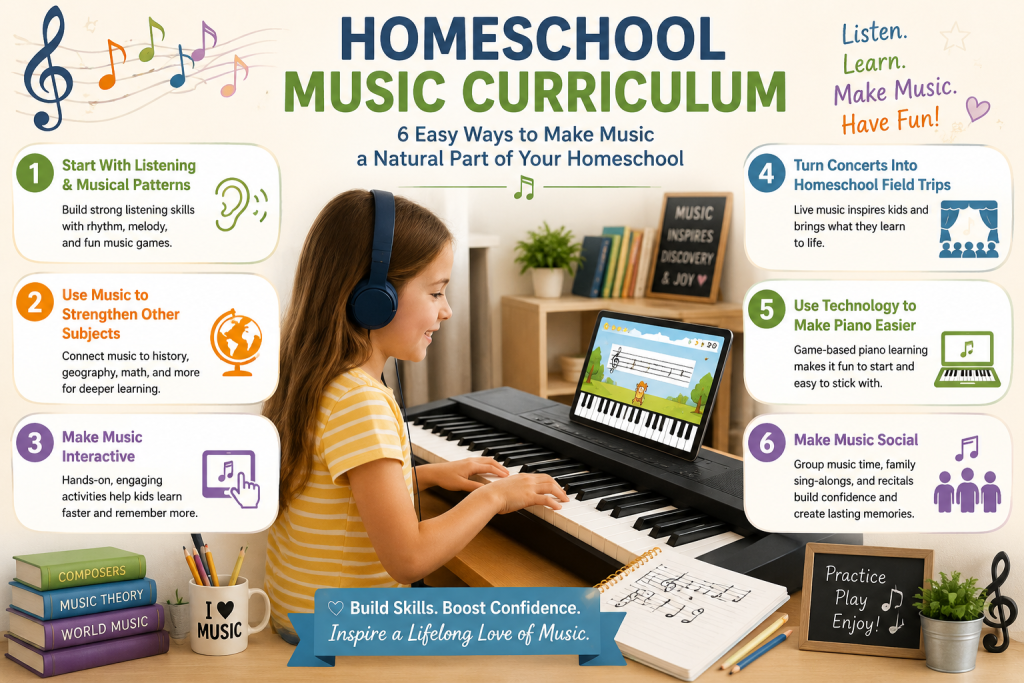
5. Let Technology Make Piano Easier to Start
Technology has made music education much more accessible for homeschool families.
Children can now hear demonstrations, slow down difficult sections, repeat lessons, receive immediate feedback, and practice at their own pace.
For piano in particular, interactive learning can remove one of the biggest early obstacles: asking children to understand traditional notation before they have experienced the fun of actually playing.
Piano Wizard takes a different approach.
Children first learn to connect visual cues with the keys they are playing. As they progress, those visual cues gradually transform into traditional music notation.
The goal is not to avoid reading music. It is to give children a more intuitive path toward it.
For homeschool parents who do not play piano themselves, that can be especially useful because the program does much of the instructional heavy lifting.
If you want to make piano a regular part of your homeschool, read How to Add Piano to Your Homeschool Curriculum the Easy Way for a more detailed step-by-step approach.
6. Make Music Social
Homeschooling does not mean children have to learn music alone.
Music is naturally social.
If you belong to a homeschool group or co-op, consider organizing an informal music session. Children can take turns playing, singing, clapping rhythms, or showing one another what they have learned.
Siblings can play together. Parents can participate even if they are beginners. Grandparents and friends can become an audience for small living-room performances.
The point is not to create competition.
It is to make music feel like something people share.
Even a simple monthly "music day" can give children a reason to practice and an opportunity to celebrate their progress.
You Do Not Need to Be a Music Teacher
One of the advantages of homeschooling is that you do not have to recreate a traditional classroom at home.
That applies to music too.
You do not need to know everything before your child begins. You can listen together, explore together, learn together, and use tools that make the process easier.
A successful homeschool music curriculum does not have to begin with theory books and formal lessons.
It can begin with curiosity.
Listen to music. Clap rhythms. Attend a concert. Explore an instrument. Let your child play.
Then build from there.
Ready to Add Piano to Your Homeschool?
Piano Wizard was designed to help children start making music quickly through an interactive, game-based approach that gradually leads them toward traditional piano playing and music reading.
Explore Piano Wizard Academy and see how families are using it to make piano a practical part of learning at home.
You can also visit our Success Stories to see how other children and families have progressed with Piano Wizard.