
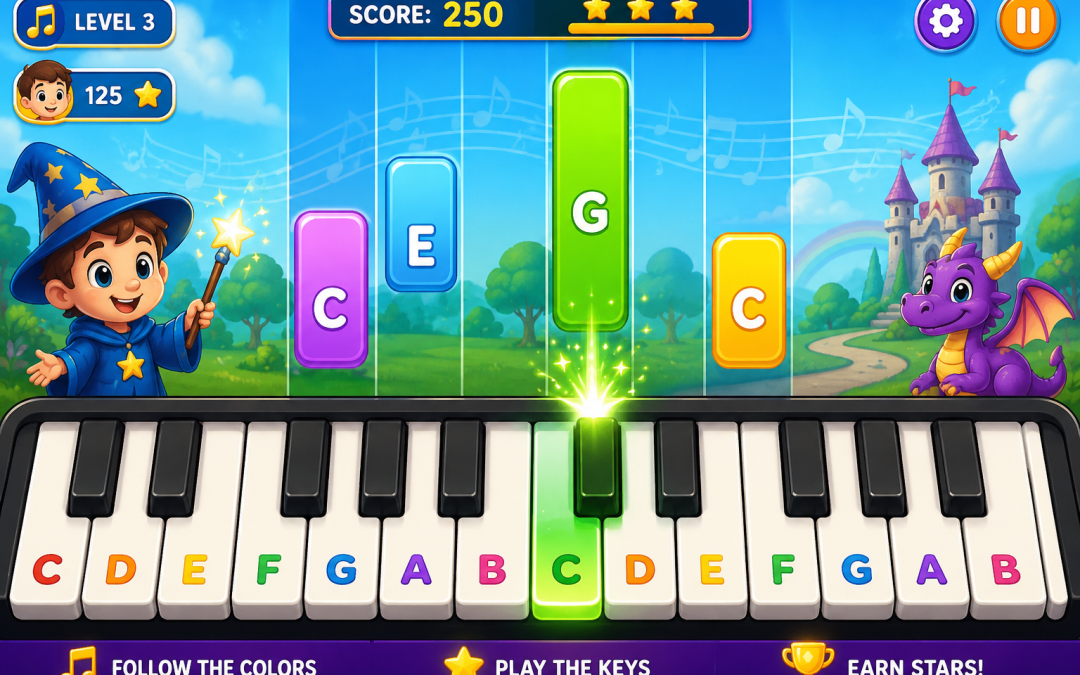
Piano games for kids can turn early music learning into something children actually look forward to.
Young children often enjoy activities that involve seeing patterns, using their hands, solving simple challenges, and getting immediate feedback. Piano fits naturally into that kind of learning because children can press a key, hear the result, and begin making connections right away.
If your child is taking piano lessons, preparing to start lessons, or simply exploring music at home, simple piano games can help build useful skills before practice ever starts to feel like work.
And you do not need to be a piano teacher to use them.
Why Piano Games Work Well for Young Learners
Children often learn best when they can interact with what they are learning.
Instead of only being told where notes are or how rhythm works, they can see it, hear it, touch it, and repeat it.
Piano games can help beginners practice:
- Keyboard awareness
- Note recognition
- Rhythm and timing
- Finger numbers
- Hand coordination
- Listening skills
- Pattern recognition
- Confidence at the keyboard
The goal is not to replace real piano instruction. The goal is to make the first steps more engaging and easier to understand.
1. Find the Keys Game
Start with one of the simplest piano games for kids: finding groups of black keys.
Ask your child to find all the groups of two black keys on the keyboard, then all the groups of three.
Once that becomes easy, show them how the white notes repeat around those patterns.
For example, middle C can be found just to the left of a group of two black keys.
This helps children begin seeing the keyboard as a repeating pattern instead of a long row of unrelated notes.
2. Musical Alphabet Challenge
The musical alphabet only uses seven letters:
A, B, C, D, E, F, G
Turn that into a quick game.
Call out a letter and ask your child to find that note on the keyboard. Then reverse it. Point to a key and ask them to name the note.
You can also ask:
- What comes after C?
- What comes before G?
- What happens after G?
This reinforces the repeating musical alphabet without turning it into memorization drills.
3. Rhythm Copy Game
You do not even need the keyboard for this one.
Clap a short rhythm and ask your child to copy it.
Start with something simple, then make the patterns slightly longer.
You can also tap the rhythm on the piano lid, a table, or your knees.
Once your child can copy the rhythm, let them create one for you to repeat.
This helps develop timing, listening, memory, and the ability to recognize musical patterns.
4. Finger Number Game
Piano students use numbers to identify their fingers.
Each thumb is finger 1, and the numbers continue outward to finger 5.
Turn this into a quick challenge.
Call out a finger number and ask your child to raise the correct finger.
Then place their hand on the keyboard and ask them to play one key with that finger.
You can make the game faster as they improve.
This helps children become comfortable with finger numbers before they encounter them regularly in piano music.
5. High Note, Low Note
Play two notes and ask your child which one sounds higher.
Then ask which one sounds lower.
Move farther apart on the keyboard at first so the difference is obvious. As your child improves, move the notes closer together.
This simple listening game helps children connect pitch with movement across the keyboard.
They begin to understand that notes generally sound lower as they move left and higher as they move right.
6. Piano Pattern Hunt
Children are naturally good at spotting patterns.
Play a simple sequence of two or three notes and ask them to find the same pattern somewhere else on the keyboard.
You can also create visual patterns using finger numbers or note names.
For example:
1 - 2 - 3 - 2 - 1
or:
C - D - E - D - C
Repeating patterns help children understand one of the most important ideas in music: much of what we play is built from smaller patterns that repeat or change.
7. Play a Song by Matching Visual Cues
This is where a piano keyboard game can take the idea much further.
Instead of simply identifying individual notes, children can follow visual cues and use them to play an actual song on the keyboard.
That immediate connection between seeing, pressing, and hearing can make the early stages of learning much more rewarding.
With Piano Wizard, students begin with colorful visual cues that show them which keys to play.
As they progress, those visual cues gradually transition toward traditional music notation.
The goal is not just to play a game. It is to use the game as a bridge toward real piano skills.
8. Turn Practice Into a Challenge
Even ordinary practice can become more engaging when you turn it into a small challenge.
Try goals such as:
- Play the pattern three times without stopping
- Find five C notes as quickly as possible
- Play a song slightly slower with perfect accuracy
- Beat yesterday's score
- Play a short section without looking at your hands
The challenge should be achievable.
The point is not pressure. It is to give the child a clear goal and a reason to notice improvement.
What Skills Can Piano Games Help Build?
Well-designed piano games can help reinforce skills that later become part of more traditional piano study.
These include:
- Reading and recognizing musical symbols
- Counting rhythm
- Coordinating both hands
- Following patterns
- Listening carefully
- Setting small goals
- Practicing consistently
- Taking responsibility for progress
Most importantly, children begin associating the piano with success and discovery instead of frustration.
If you’re choosing a first instrument, Yamaha offers a useful beginner’s guide to 61-key keyboards versus 88-key pianos that can help parents understand the tradeoffs.
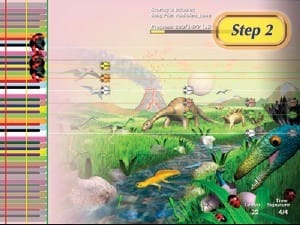
How Piano Wizard Uses Game-Based Learning
Piano Wizard was built around the idea that beginners should experience the reward of making music early.
Students begin by interacting with a visual game while playing a real piano or MIDI keyboard.
They learn to connect what they see with the keys they play and the sounds they hear.
As their skills develop, the game gradually introduces the visual structure of traditional music notation.
This makes Piano Wizard more than a collection of piano games for kids. It is a step-by-step learning system designed to move students from game-based play toward real keyboard and music-reading skills.
Make Piano Something They Want to Come Back To
The early years of learning music should build curiosity, confidence, and a desire to keep going.
You do not need complicated exercises to begin.
Start with simple games.
Find the keys. Clap rhythms. Practice finger numbers. Look for patterns. Play short songs.
Then build from there.
When learning feels rewarding, children are much more likely to return to the keyboard and continue developing their skills.
Explore the Piano Wizard Piano Keyboard Game and see how game-based learning can help children turn practice into play.